
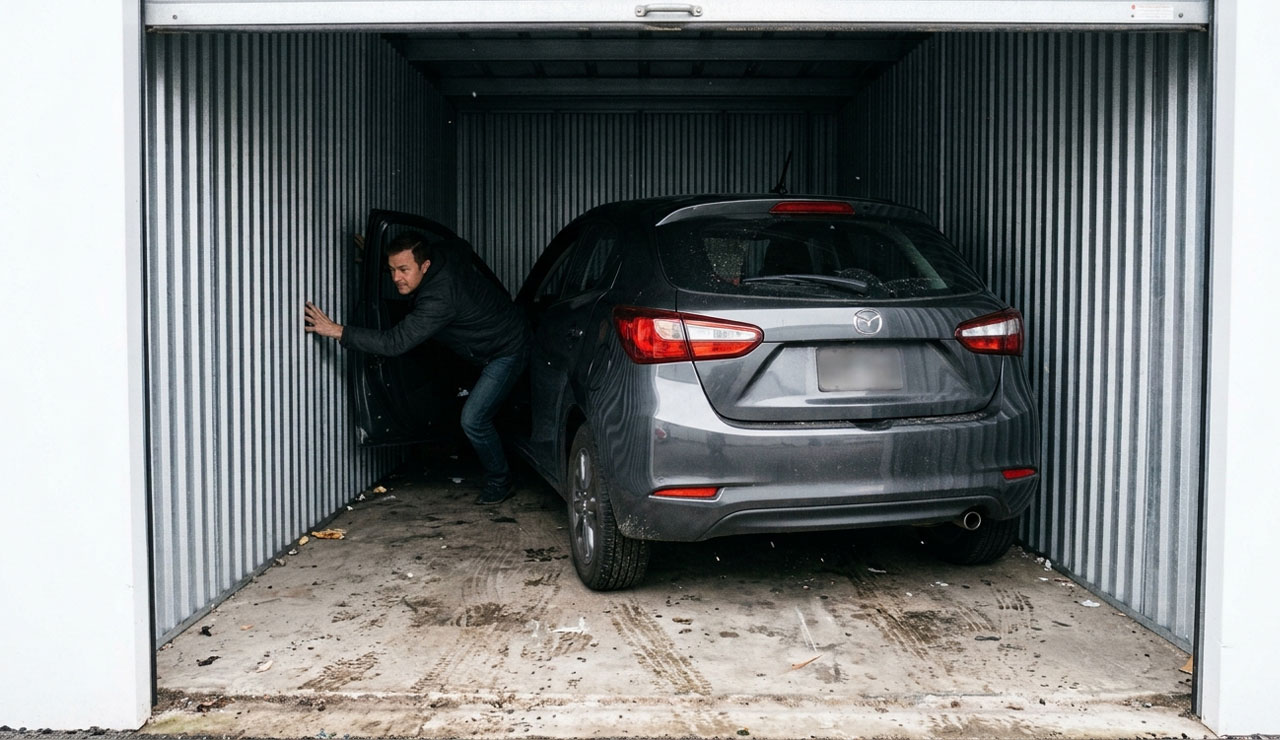
If you want the short version before spending an afternoon with a tape measure: yes, your motorcycle will fit in both a 10x10 and a 10x15 without breaking a sweat. Your car, on the other hand, almost certainly will not. It has zero chance in a 10x10, and unless you drive a two-seat roadster or a vintage microcar, trying to wedge it into a 10x15 is one of those ideas that looks brilliant on paper right up until you find yourself trapped in the driver seat, unable to open your door more than four inches against a corrugated steel wall.
People make this mistake every single autumn across Canada. They look up their car length on Wikipedia, see that their sedan is fourteen and a half feet long, look at a 10x15 listing, and figure they have six inches of cushion to spare. Then moving day arrives, the rear bumper overhang catches the downward track of the roll-up door, and the facility manager walks over with a clipboard to tell them they need to transfer to a 10x20.
Before you haul anything down to an access gate, here is how the numbers actually work once you are inside the stall.
| Storage Unit Size | Motorcycles | Cars & Small Roadsters | Full-Size SUVs & Trucks |
|---|---|---|---|
| 5x10 (50 sq. ft.) | 1 street bike comfortably | Will NOT fit | Will NOT fit |
| 10x10 (100 sq. ft.) | 2–3 bikes + gear | Microcars only (Smart Fortwo) | Will NOT fit |
| 10x15 (150 sq. ft.) | 3–4 bikes + tools | Short roadsters (Miata / Fiat 500) | Will NOT fit (door won't shut) |
| 10x20 (200 sq. ft.) | 5+ bikes / workshop | Fits most everyday sedans & SUVs | Tight on crew cab trucks |
| 10x25 / 10x30 | Fleet storage | Fits any car with extra room | Fits full-size pickups (F-150 / RAM) |
Storing Motorcycles: Why Two Wheels Have It Easy
For bikes, a 10x10 or 10x15 feels practically palatial. Most standard street bikes, sport machines, and naked roadsters sit right around seven feet long from the front tire tread to the edge of the license plate holder. Handlebars generally span between thirty and thirty-four inches. Even if you are parking an eight-hundred-pound bagger like a Harley Street Glide or an Indian Roadmaster, you are looking at roughly eight and a half feet of total length and a three-foot bar width once you account for highway pegs and side mirrors.
In a ten-by-ten locker, a single large touring bike parked along one wall leaves you with roughly seventy square feet of open concrete. That is more than enough room to stack a second set of car tires, tuck away snowboards, and line the opposite wall with plastic totes full of your leather suits, boots, and riding luggage.
If you share the space with a buddy or put two family bikes away for the winter, the ten-by-ten still handles the job comfortably. The trick is avoiding the rookie mistake of pulling both bikes in side by side facing the exact same direction. Handlebars collide, bar-end mirrors get scratched, and kickstands end up tangling.
Instead, nose the first bike deep into the front left corner, then back the second machine in along the right wall. This head-to-tail arrangement staggers the wide handlebars against the narrower rear fenders, leaving plenty of elbow room in between.
Keep kickstand lean in mind. A motorcycle on its side stand tilts anywhere from ten to fifteen degrees, which quietly steals another eight inches of floor space on the kickstand side. If you use an inexpensive front-wheel paddock chock that holds the front tire upright and true, both machines remain perfectly vertical. You save floor width and eliminate the risk of a clumsy bump knocking one heavy bike into the other.
Also, never drop a steel kickstand directly onto unsealed storage concrete for four months of freezing Canadian weather. Concrete pads act like massive moisture sponges in unheated drive-up buildings. That cold humidity leaches upward through the steel and pits the chrome or aluminum finish on your stand. Slide an old rubber hockey puck or a six-inch scrap of plywood under the foot, and your kickstand will come out in April looking exactly like it did in October.
Jump up to a 10x15, and you can comfortably park three full dressers or four standard sportbikes with an entire walking alley straight down the middle, meaning you never have to wheel three bikes into the driveway just to take the rear one out for an early spring tune-up.
The Math Behind Why a Car Will Not Fit in a 10x10
Every year someone calls our office asking if they can park a compact car in a 10x10 because their lease says the unit is one hundred square feet, and their car is roughly sixty square feet of footprint.
The width of ten feet is not what kills you. The ten feet of depth is.
Modern cars are simply much longer than people picture in their heads. Take the most ubiquitous compact commuters on Canadian roads. A current Honda Civic sedan measures just over fifteen feet and four inches from bumper to bumper. A Toyota Corolla sedan stretches just past fifteen feet two inches. Even a stubby hatchback like a Volkswagen Golf or a Mazda 3 stretches over fourteen feet.
If you drive a standard Civic nose-first into a 10x10 unit until your front license plate bracket literally presses against the back wall, your entire rear seat, trunk lid, and rear bumper are still hanging out in the driveway. The heavy steel door will come down directly across the middle of your roof.
The only production road cars built in modern history that can physically fit inside a 10x10 are two-seater microcars designed for congested European alleys. A Smart Fortwo measures eight feet ten inches, leaving you about fourteen inches of total end-to-end breathing room. An original vintage Austin Mini from the sixties measures dead-on ten feet, which means it would touch both walls like an egg in a carton.
Unless you are preserving a Smart car, write off the 10x10 entirely for anything with four wheels.
The 10x15 Car Trap: Door Tracks, Egress, and Scratching Metal
This is where the real frustration happens. A 10x15 unit sounds plausible because fifteen feet equals one hundred and eighty inches. If you drive a subcompact car that measures one hundred and sixty inches, simple arithmetic tells you that you have twenty inches of buffer space. You think you can split the difference with ten inches in front and ten inches in back.
What the brochure never tells you is how self-storage buildings are physically constructed.
First comes the roll-up door assembly. Drive-up storage lockers do not feature residential garage doors that retract flat along the ceiling. They use industrial roll-up curtain doors made of heavy ribbed steel that coil into a massive drum directly above the opening. The vertical steel tracks that guide this door do not sit flush with the exterior siding. They are anchored inside the door jamb, stealing two to four inches of usable interior length right at bumper height.
When your vehicle is parked with only four or five inches of theoretical clearance, those metal door slats will rub, scrape, or catch against your rear bumper lip, license plate frame, or exhaust tip as you pull the door down to padlock it.
Then comes the bigger problem: human egress. Storage stalls are usually built with ten-foot interior widths, but the door cutout itself is typically only eight feet wide. Even if you center your car perfectly inside that ten-foot space, a modern compact vehicle is about six feet wide from door skin to door skin, without even counting the side mirrors.
That leaves you roughly twenty inches between the car door and the wall on the driver side. Modern vehicle doors are thick, packed with side airbags, speakers, and impact reinforcement bars, and they are built with stepped mechanical door checks. The first detent position alone swings the door out twenty-four inches.
If you drive in, you will crack the door open, hit the ribbed steel wall with a sickening metallic clatter, and realize you cannot get your shoulders out. You either have to slide across the center console and crawl out the passenger side—which has the exact same clearance problem—or contort yourself backward and climb out through the rear hatch or a glass sunroof.
People who successfully keep a car in a 10x15 never actually drive it inside. They line the vehicle up perfectly in the exterior lane, drop the transmission into neutral with the parking brake off, and recruit a second person to manually push the car over the door threshold into the bay. Once it is situated with three inches to spare, they reach through the open driver window to click the emergency brake, throw rubber wheel chocks under the tires, and walk away.
That extreme hassle only works for genuinely tiny, short-wheelbase vehicles. A modern Mazda MX-5 Miata stretches just under thirteen feet, giving you roughly two feet of total end buffer. An older Fiat 500 comes in under twelve feet, making it one of the rare modern vehicles that parks in a 10x15 without sheer panic.
If you own an everyday compact sedan like an Elantra, Civic, Corolla, or Jetta, you are over fifteen feet. You are simply too long for the building.
The Realistic Minimums: 10x20 and Beyond
If you want to park a regular car, get out like a dignified human being, and lock the latch without sweating bullets, you start at a 10x20.
A twenty-foot depth gives you two hundred square feet of surface area, which matches the dimensions of an average single-car garage in a suburban home. In a 10x20, an Accord, Camry, RAV4, or Model 3 rolls in with four feet of spare length. That cushion lets you step out comfortably, walk around both ends of the vehicle without scraping your winter coat against dirty walls, and gives you space along the back wall to stack seasonal wheels or storage boxes.
For full-size pickups and large family haulers, even a 10x20 becomes a tight squeeze. A standard crew cab Ford F-150 with a short bed measures between nineteen and twenty feet long from front bumper to tailgate. If you have a tow hitch receiver ball sticking out of the back or a brush guard mounted on the front, you will cross the twenty-foot mark before you realize it.
Driving a half-ton or three-quarter-ton truck into a 10x20 usually means your front bumper kisses the drywall while the roll-up door grazes your rear bumper step. For full-size trucks, large three-row SUVs like a Suburban or Tahoe, or extended commercial vans, skip the gamble and look for a 10x25 or 10x30 drive-up bay. The extra five feet saves your bumpers and gives you the wider turning radius you need to swing a long wheelbase into a narrow facility alleyway.
What Canadian Facilities Actually Demand Before You Park
You cannot simply show up with a car key, swipe a credit card, and leave a vehicle parked behind a roll-up door. Storage operators across Canada treat motorized vehicles differently than furniture because gas tanks, brake fluid, and lead-acid batteries represent serious fire and environmental liabilities.
Expect the manager to ask for your paperwork before they hand over an access gate code. They will demand to see valid vehicle ownership registered in your legal name alongside matching government photo identification. If you just bought a project car on an open bill of sale without having transferred the registration at the provincial service bureau, most facility managers will turn you away at the gate. Abandoned vehicles are an absolute legal nightmare under provincial repair and storage liens legislation, so facilities protect themselves ruthlessly.
You also need active insurance. Many people assume they can cancel their auto policy entirely once a vehicle is tucked away off the street, but storage facilities require active comprehensive coverage protecting against fire, theft, and building collapse. Do not rely on basic tenant insurance policies sold in the rental office either. The vast majority of those generic ten-dollar-a-month contents policies carry explicit clauses excluding motorized vehicles with road registrations. Your auto insurer must issue a comprehensive storage endorsement.
Then there is the fuel rule. Provincial fire marshals prohibit storing massive volumes of combustible fuel inside unvented commercial lockers. Almost every facility lease limits you to a maximum of one-quarter tank of gasoline when you pull into the stall.
Before parking for a cold Canadian winter, run your tank down low, pour in an honest dose of quality fuel stabilizer at the gas station down the street, and drive the car for ten or fifteen minutes to ensure that treated fuel works its way through the fuel pump, lines, and injectors. Never leave loose jerry cans or fuel jugs sitting inside the locker; management will confiscate them on inspection day.
Concrete protection is equally non-negotiable. Raw poured concrete absorbs oil and transmission fluid instantly, leaving permanent stains that facilities will bill you hundreds of dollars to acid-wash or grind out when you move out. Pick up an oil-resistant containment mat or a large plastic drip pan to place directly under the engine and transmission before closing the door.
Lastly, do not expect to find wall outlets in a standard drive-up locker. If you were hoping to plug in a continuous battery tender to keep your motorcycle or car battery healthy through a deep sub-zero January freeze, you are out of luck.
Unhook the negative battery terminal to stop parasitic computer draw, or better yet, pull the battery out with a socket set, carry it home in your trunk, and keep it on a smart charger on a workbench in your basement until the snow melts. That small effort guarantees that when you swing the roll-up door open in the spring, your engine turns over on the very first crank.